


ISA
The Individual Savings Account (ISA) is one of the most straightforward ways to achieve tax-efficient gains. Investing in an ISA can complement an existing portfolio, or simply provide an introduction to saving and investing. Individual Savings Accounts were introduced in April 1999 to replace old style PEPs (Personal Equity Plans) and Tessas (Tax-Exempt Special Savings Accounts).
There are five types of Individual Savings Accounts; Cash ISA, Stocks & Shares ISA, Lifetime ISA, IFISA and a Junior ISA. Please note that Help To Buy ISA’s are no longer available to new applicants.
An Individual Savings Account is a ‘tax-efficient wrapper’. This is designed to go around an investment.

An ISA is a tax-efficient way to invest because your money is shielded from Income Tax, Tax on Dividends and Capital Gains Tax.

Cash ISA
These are simple savings accounts where you don’t pay tax on your interest. They mainly offer instant access to your money. However, some Fixed Term Cash ISAs are also available where withdrawals will be restricted.
Any interest you earn in a cash ISA doesn’t count towards your personal savings allowance. Therefore, if you will earn a lot of interest, you can protect more of it in an ISA. There are a variety of Cash ISAs:
- Easy-access Cash ISAs:
You can access any of the money you have put in, whenever needed without a penalty.
- Notice Cash ISAs:
If you wanted to withdraw any amount of money from this ISA, you would need to give a certain number of days’ notice. This gives you the option of withdrawing money, on the condition of being able to wait for it.
- Fixed Rate Cash ISAs:
Fixes tend to offer higher rates than easy-access or notice ISAs. However, if you need to withdraw any of your money, you will usually have to pay an interest penalty.
Stocks & Shares ISA
A Stocks & Shares ISA is where you can invest with your ISA allowance.
These are share based investments in various forms. A Self Select ISA allows you to hold shares in individual companies. These are usually managed by stockbrokers.
However, a more common use of the shares allowance is for collective investment vehicles. Such as, unit trusts, OEICs or investment trusts. These are pooled investments where a fund manager picks a selection of shares based on geographic or sector criteria. The value of the investment depends on the collective performance of the shares picked.
As well as holding shares (equities), Stocks & Shares ISAs can also invest in property funds and bonds. Such as gilts, corporate bonds and high yield bonds.
Placing investments inside an ISA wrapper provides two potential tax advantages. The main benefit is that any capital growth can be returned to you free from Capital Gains Tax. Also, if your fund invests in bonds, then the fund manager can reclaim all tax paid on the interest.
- Funds which can be Shares or Bonds from a variety of companies pooled into one investment.
- Bonds which are a loan to a company or a government.
- Shares in individual companies.
Whenever you are investing, there is always a risk. This is why it is very important to have a Financial Advisor go through your risk attitude and guide you through the process. The general consensus of Stocks & Shares is that it is a long-term game. Therefore, you should have money put aside for five years to take into consideration any ups and downs in the market.
There are usually fees which you have to pay associated with Stocks & Shares ISAs, such as:
- Platform Charge:
This can either be a flat fee or a percentage of the value of your funds.
- Annual Management Charge:
This charge can typically vary from 01% to 1%+ per fund. The charge is paid to the manager of the fund held within your Stocks & Shares ISA.
- Trading Fees:
This is the cost every time you buy or sell shares or funds. These can be anything from £0 to £25.
- Transfer Out Fee:
The cost involved in moving your Stocks & Shares ISA from one platform to another.
Lifetime ISA
Lifetime ISAs were launched to help people save for their first home, or for their retirement.
The Lifetime ISA is a longer-term tax-free savings account. In addition, the government will give you a bonus of 25% of the money you put in. This is up to a maximum of £1,000 a year.
As with other ISAs, you won’t pay tax on any interest, income or capital gains from cash or investments held within a Lifetime ISA.
Lifetime ISAs can hold cash, stocks and shares qualifying investments, or a combination of both. You can save up to £4,000 a year, and can continue to pay into it until you reach 50.
The account can stay open after then, but you can’t make any more payments into it. Your savings will be kept on a tax-free basis for as long as you keep the money in your Lifetime ISA.
To open a Lifetime Individual Savings Account, you must be aged 18 or over but under 40.
You must also be either:



There are two different types of Lifetime ISA:
- Cash Lifetime ISAs:
If you are planning to buy your first home within the next couple of years, this may be the better choice as there are no risks to your savings and you will be sure of how much money you have.
- Stocks & Shares Lifetime ISA:
If you are saving for retirement or buying your first home is a long way off, this may be the better option for you. Please note, whenever you are investing, you should be prepared for any highs and lows in the stock markets.
Junior ISA
This is a savings and investment vehicle for children up to the age of 18. It is a tax-efficient way to save or invest as it is free from any Income Tax, tax on dividends and Capital Gains Tax on the proceeds. The Junior ISA subscription limit is currently £9,000 for the tax year 2024/25. Your child can access the account at the age of 16 but can only have the money when they have turned 18.

Helpful Q&A
We have answered some typical questions we get asked about how best to use the ISA allowance to help make the most of the opportunities as this tax year draws to a close.
Can I have more than one ISA?
You have a total tax-efficient allowance of £20,000 for this tax year. This means that the sum of money you invest across all your ISAs this tax year (Cash ISA, Stocks & Shares ISA, Innovative Finance ISA, or any combination of the three) cannot exceed £20,000. However, it’s important to bear in mind that you have the flexibility to split your tax-free allowance across as many ISAs and ISA types as you wish.
For example, you may invest £10,000 in a Stocks & Shares ISA and the remaining £10,000 in a Cash ISA. This is a useful option for those who want to use their investment for different purposes and over varying periods of time.
What happens to my ISA if I die prematurely?
The rules on ISA death benefits allow for an extra ISA allowance to the deceased’s spouse or registered civil partner.
When will I be able to access the money I save in an ISA?
Some ISAs do tie your money up for a significant period of time. However, others are pretty flexible.
If you’re after flexibility, variable rate Cash ISAs don’t tend to have a minimum commitment.
This means you can keep your money in one of these ISAs for as long – or as short – a time as you like. This type of ISA also allows you to take some of the money out of the ISA and put it back in without affecting its tax-efficient status. On the other hand, Fixed-Rate Cash ISAs will typically require you to tie your money up for a set amount of time. If you decide to cut the term short, you usually have to pay a penalty. But ISAs that tie your money up for longer do tend to have higher interest rates.
Stocks & Shares ISAs do not usually have a minimum commitment, which means you can take your money out at any point. That said, your money has to be converted back into cash before it can be withdrawn.
Is tax payable on ISA dividend income?
No, no tax is payable on dividend income. You don’t pay tax on any dividends paid inside your ISA.
Outside of an ISA, you currently receive a £2,000 dividend income allowance.
Can I transfer my existing ISA?
Yes, you can transfer an existing ISA from one provider to another at any time as long as the product terms and conditions allow it. If you want to transfer money you’ve invested in an ISA during the current tax year, you must transfer all of it. For money you invested in previous years, you can choose to transfer all or part of your savings.
I already have ISAs with several different providers. Can I consolidate them?
Yes you can, and you won’t lose the tax efficient ‘wrapper’ status. Many previously attractive savings accounts cease to have a good rate of interest, and naturally some Stocks & Shares ISAs don’t perform as well as investors would have hoped. Consolidating your ISAs may also substantially reduce your paperwork. We will be happy to talk you through the advantages and disadvantages of doing it.
Is Capital Gains Tax (CGT) payable on my ISA investment gains?
No, you don’t have to pay any CGT on profits.
You make a profit when you sell an investment for more than you purchased it for. If you invest outside an ISA, excluding residential property, any profits made above the annual CGT allowance for individuals (£12,300 in 2024/25 tax year) would be subject to CGT. For basic rate taxpayers,
CGT is 10% or more. For higher and additional rate taxpayers, CGT is 20%.
Want to make the most out of your ISA allowance?
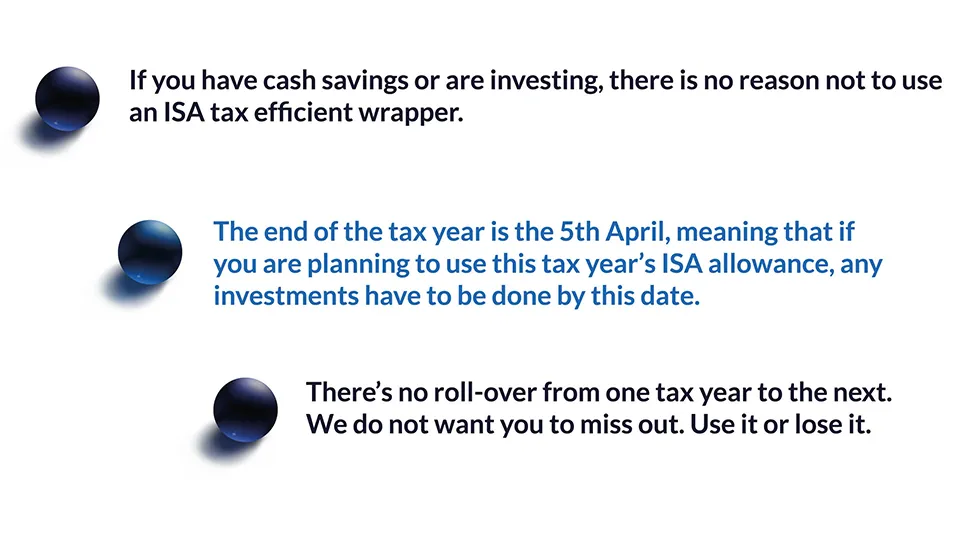
There’s no roll-over from one tax year to the next. We don’t want you to miss out!

Related Articles
The following will give you further insight into this service.
Guide

Responsible Investing
Guide

Why You Should Carry Out a Financial Review
News
