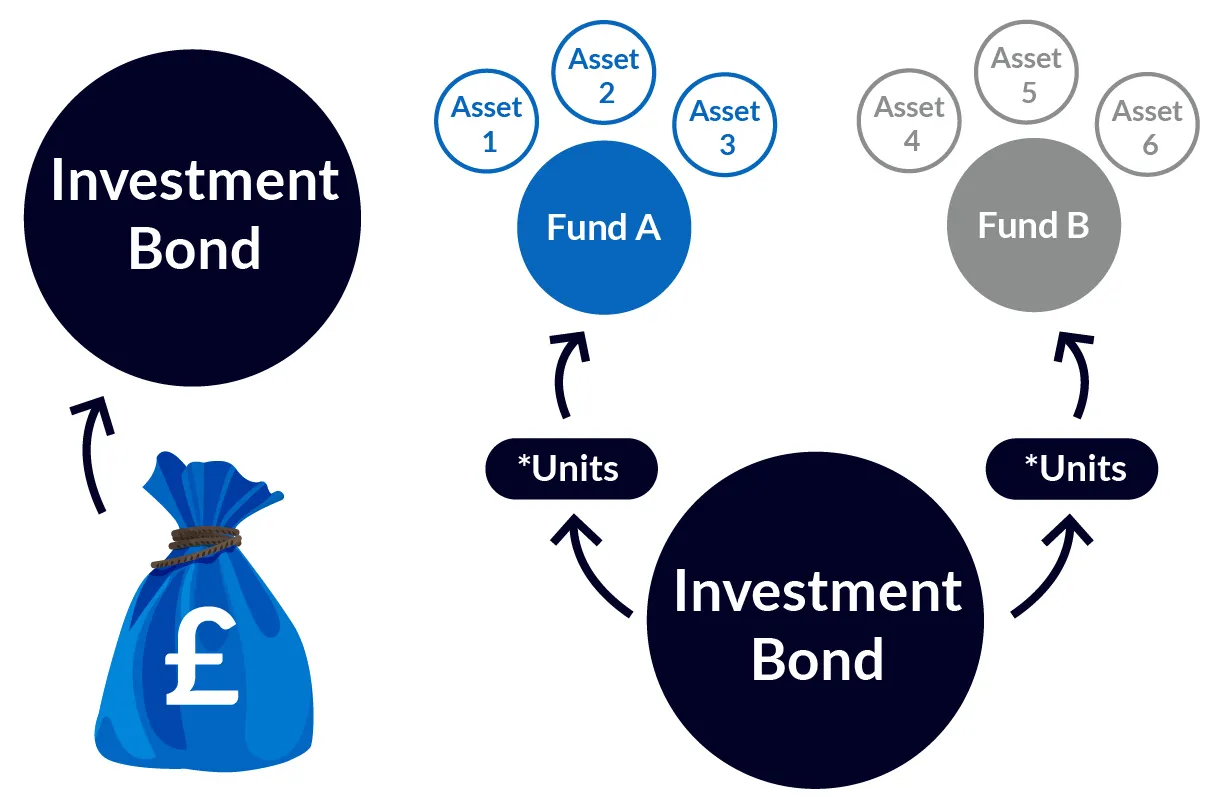
Investment bonds are offered by life insurance companies. They are a way of allowing you to invest in a mixture of investment funds.
Professional investment managers manage the funds.
The design of each fund is to provide a benefit for different types of investor.
A common element is that they aim to produce long term capital growth and / or generate a long term return.
Investment Bonds are just investment tax wrappers.
Investment Bonds are not ‘bonds’. Bonds are effectively loans in the forms of gilts, corporate bonds and high yield bonds.
When you invest in an Investment Bond, you are allocated a number of units in the fund of your choice.
Each fund will invest in a range of assets.
The price of your units will normally rise and fall in line with the value of these assets.
Investment bonds are single premium life insurance policies. Therefore, this means that a small element of life insurance is provided. Life Insurance pays out after your death.
What Are The Main Benefits Of An Investment Bond?
Regular withdrawals can be taken.
– For instance, by taking your regular withdrawals, you can supplement any other income you have. You can choose to withdraw a set amount or a set percentage of the amount you originally invested.
Tax Benefits.
– The life fund will pay corporation tax on any gains it receives. As a result, this will satisfy the liability to basic rate tax. For example, you can withdraw up to 5% of the capital amount invested each policy year without triggering an immediate chargeable event for up to 20 years. This allowance is limited to the amount of capital invested. Annual withdrawals of 5% can be taken for 20 years.
You can choose to invest in a range of funds.
– This enables you to diversify risk by investing in a range of funds, or to tailor an investment strategy to a specific fund or group of funds.
Also you can choose a portfolio.
– Or you can choose a mixture of both fund and a portfolio. Adding a portfolio will enable your money to be managed by a third party, meaning that a Portfolio Manager can ensure your investment strategy is adapted to changing market conditions and remains in line with your tolerance for investment risk.
You can usually switch between funds within your bond.
– Most bond providers will allow you to switch from one fund to another during the year, ensuring that strategies can be changed to meet your changing requirements.
Investments Bonds can be written in trust.
– This can be useful in inheritance tax planning matters. As investment bonds don’t produce a natural income or require a tax return to be submitted, they are a popular choice for Trustees looking to negate inheritance tax.
Offshore Investment Bonds
An Offshore Investment bond effectively has the same features as a normal Onshore Investment Bond.
However, it has additional tax benefits. The offshore life fund pays no corporation tax on any gains it receives.
Interest and dividends benefit from ‘gross roll-up’. Therefore, you will not be liable for tax on income and gains of underlying investment funds.
In addition, as with the onshore investment bond, you can withdraw up to 5% of the capital amount invested each policy year. You can do so without triggering an immediate chargeable event for up to 20 years. However, this allowance is limited to the amount of capital invested. Annual withdrawals of 5% can be taken for 20 years.
Having a full financial review has many benefits. First, you need to decide whether it is right for you and your situation. This Case Study shows the type work and planning we carried out for Mr & Mrs W in their financial review.
I have been delighted with the friendly, professional and personal service I receive from Choice Financial Solutions. It was particularly important to me after a significant change in personal circumstances to have the confidence that I was getting expert advice from someone who knew me and the family and could tailor solutions to best fit with us. The yearly meetings with John are very valuable as it is important to me that I can get advice from someone I trust and know I can reply on, and on the occasions where I have contacted John with a query or concern I have always had a prompt and efficient reply… That is why I am still a client!
Sarah SEast Wellow
Excellent service from start to finish.
AndrewHavant
We have been using Choice since they started business. John Quaif is always clear and honest, qualities that have endeared him to us. If there is an issue he’s quick to deal with it and does so having full regard for the client’s perspective. In a way that’s an even more powerful confirmation of the principles underpinning the company. John took over management of our pensions and rapidly kicked things into shape, so we are indebted to him! The review sessions are always well prepared and informative. And the up to date market information is always fascinating! So far, John has managed to preserve the personal touch despite the growth of the company. This is certainly important to us.
PaulSouthampton
First class service from John Quaif. Proactive, responsive and professional at all times.
Eric WTunbridge Wells
Thank you for the recent visit and the advice that you provided. It is reassuring to see that the money we have invested is working for our future needs. We would like to express out thanks for your work on our behalf over the past few years. Choice Financial Solutions have provided an excellent professional service and clearly have their clients’ interests at heart.
David & DebbieKent
Very happy with the friendly service. Good to have meetings at home, making it more comfortable. Felt at ease with the whole process. Thank you!
Joan BFareham
A very professional and helpful service. Extremely responsive and excellent at keeping us up to date. There is no pressure when discussing the various investment options and definitely customer focussed.
Bruce MBrockenhurst
Excellent service from John Quaif and the team. I would not hesitate to recommend.
Julie GIsle of Wight
We have always been listened to and our wishes met. Our investments are long term and give reliable performance.
Alan ESouthampton
15 years of excellent service and counting.
Jim BChandler’s Ford
Outstanding service and great attention to detail has left me feeling very confident and secure in relation to my financial planning. Highly recommended.
Brian WSurrey
Reliable, prompt and trustworthy.
Jeremy GBrighton
Excellent service - always.
Pamela BWinchester
In a complex and difficult market we feel we are in safe hands.
Robert NSouthampton
Excellent service.
Mark HSouthampton
Having had interaction with several financial services companies over a number of years, it’s reassuring to find a trustworthy and diligent firm which really delivers a great service, not just the statutory minimum, but genuinely informative reporting and advisory communications. My returns have been better than expected and I feel that, as the client, I’m actually more important than simply their percentage. Well done Choice and John Quaif.
Martin BNewport IOW
Good, professional service, straightforward with no frills or hidden charges. Recommended.
Antony BSouthampton
I have worked with John at Choice for many years, and always found him to be wonderful to deal with. Nothing is ever too much trouble and the help and guidance received has always been way above what I expected.
Tony DBournemouth
Choice Financial Solutions were extremely helpful and informative at every step of my dealings with them.